
History
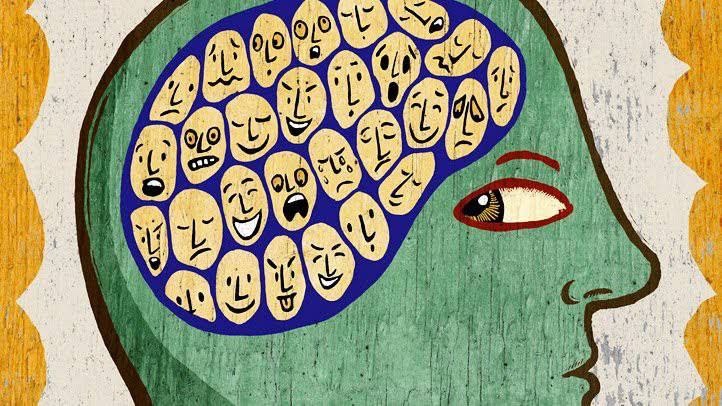
Mental illness was not well understood in ancient times. Conditions like schizophrenia were not differentiated from other forms of mental illness or mental retardation, much of which was thought of as being supernatural in origin, caused by evil spirits, demon possession, punishment for sin, or similar spiritualist phenomena. Apart from exorcism, an early remedy for such conditions was found in trepanation, a surgical procedure in which holes were drilled in the skull, perhaps as a means of letting those evil spirits out, perhaps for other, unknown reasons. Though the practice of trepanation was ultimately discontinued in developed cultures, the idea that schizophrenia was essentially a spiritual and moral problem appears to have remained dominant for hundreds, if not thousands of years.
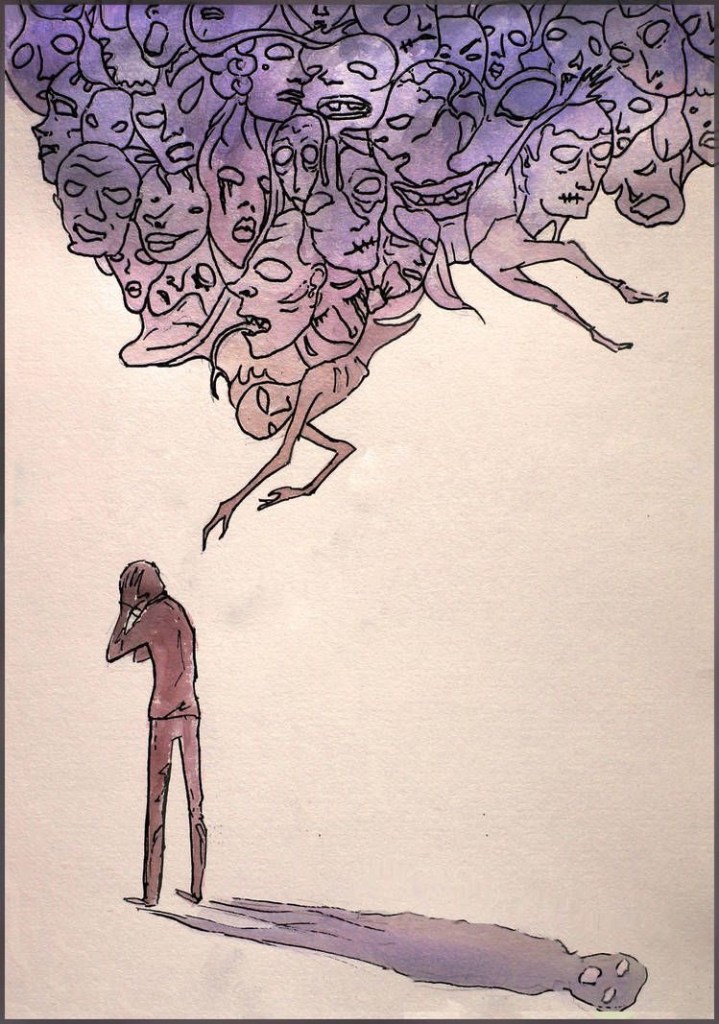
The first, formal description of schizophrenia as a mental illness was made in 1887 by Dr. Emile Kraepelin. He used the term “dementia praecox” to describe the symptoms now known as schizophrenia. Dementia praecox means “early dementia”. By calling his syndrome ‘early dementia’, he meant to differentiate it from dementias that occur later in life such as Alzheimer’s disease (senility). Correctly, Kraepelin believed that dementia praecox was primarily a disease of the brain. However, he was mistaken in believing that this disorder was a form of dementia. It is now known that schizophrenia and dementia (mental deterioration) are distinct disorders.
The term “schizophrenia” was first used in 1911 by a Swiss psychiatrist, Eugen Bleuler. It comes from the Greek roots schizo (split) and phrene (mind). Bleuler used this name to emphasize the mental confusion and fragmented thinking characteristic of people with the illness. His term was not meant to convey the idea of an actual split or multiple personality. This confusion has, however, become a common and rather entrenched myth regarding schizophrenia that continues to this day.
What is schizophrenia?
Word schizophrenia is derived from two words “schizo” & “phrenia” meaning “split” & “mind” respectively, due to this many media sources mistakes it with split personality disorder which is not at all true, it is a syndrome.
It is a type of mental disorder which leads to many symptoms like delusion, hallucination, disorganised speech, disorganised behaviour, catatonic behaviour, depression, etc.
Symptoms
Symptoms of schizophrenia can be classified broadly into three types -:
1. Positive symptoms-: By positive it doesn’t mean that they are beneficial, it means the symptoms which add to certain physiology functions which didn’t exist before.
For eg -: Delusions, hallucinations, disorganised speech, disorganised behaviour, catatonic behaviour, etc.
2. Negative symptoms-: loss of certain physiological functions or some behavioural characteristics.
For eg -: loss of interest, loss of emotions, inappropriate response, alogia, avolition, etc.
3. Cognitive symptoms-: These symptoms are very subtle and difficult to detect, and can only be detected if very specific tests are performed.
For eg -: loss of memory, affected learning, affected understanding, etc.
Phases of schizophrenia
People suffering from schizophrenia cycle through 3 phases typically in a particular order.
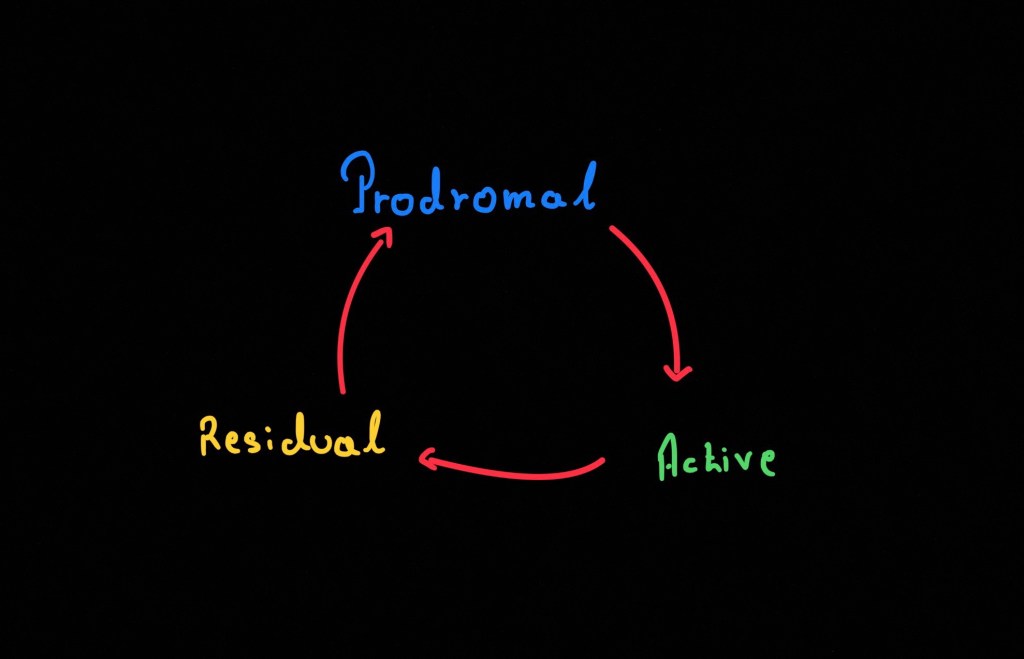
1. Prodromal phase-: in this phase patient becomes withdrawn from his/her surrounding, and he/she may lose interest in certain things which they used to enjoy before, they may try to cut themselves from their surrounding in this phase.
2. Active phase -: this is the most severe phase of the three, also it is the phase in which symptoms are the worst and are impossible to ignore so this is the phase in which most of the patients get diagnosed with the syndrome.
This phase is characterized by symptoms such as delusions, hallucinations, disorganised speech, disorganised behaviour, catatonic behaviour, etc.
3. Residual phase -: this phase is somewhat similar to prodromal phase with the addition of cognitive symptoms.
Diagnosis
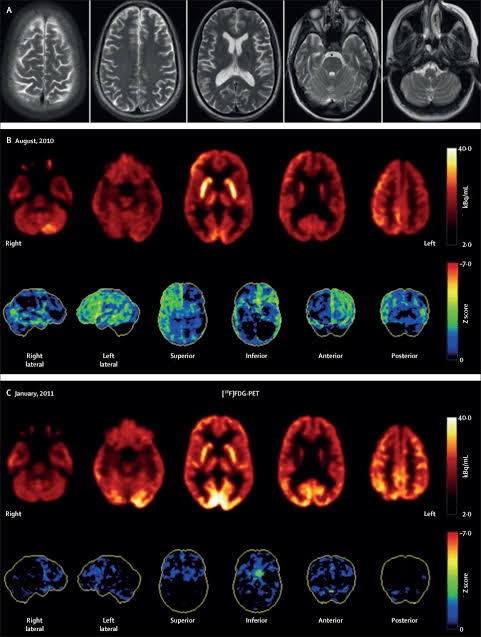
to attain the conclusive diagnosis of schizophrenia following rules are set up, they are as follows.
1. patient must show two of the following symptoms i.e. delusion, hallucination, disorganised speech, disorganised behaviour, and catatonic behaviour.
2. patient must be showing symptoms for at least 6 months and he/she must be in the active phase for at least a month.
3. symptoms shown by the patient can’t be attributed to any other condition like substance abuse.
Causes
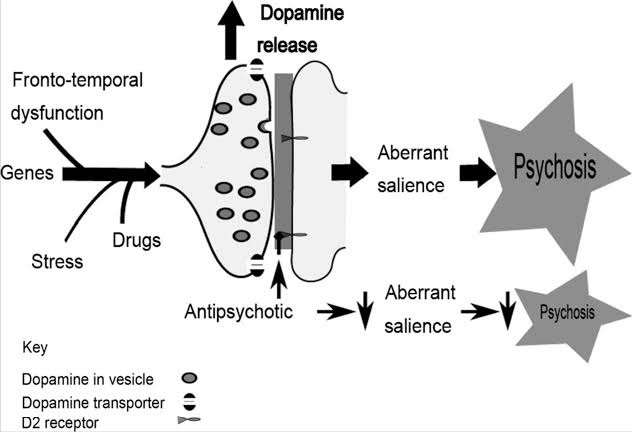
the truth is we’ve not quite understood the causes of schizophrenia yet, but we have some evidence to trace its roots like-
Many antipsychotic drugs are given to the patient act by blocking D2 dopamine receptors, and these drugs are very effective in improving schizophrenia symptoms, which gives us the hint that the syndrome has to do something with increased dopamine concentration.
The newer medications not only intervene with dopamine but also with other neurotransmitters like GABA, norepinephrine and serotonin which are more effective in improving the symptoms, hence suggesting their role in the syndrome too.
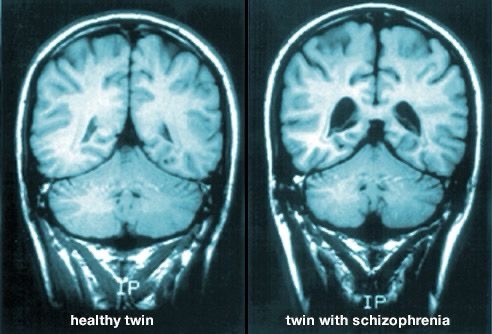
Schizophrenia has the strongest genetic links of all psychotic disorders, although it is seen in 1% of the total world population, studies show that an identical twin of an affected person has a 40% chance to get the syndrome. We are almost certain that this disorder is linked to multiple genes but we’ve not conclusively found which genes are they.
Studies have shown that environment also plays some part in the onset of this disorder, i.e. early/prenatal infections, autoimmune disorders, etc.
It is seen males are slightly more prone to get this syndrome than females, and also it is observed that in males onset of schizophrenia takes place in the early twenties and the late twenties in females.
Treatment
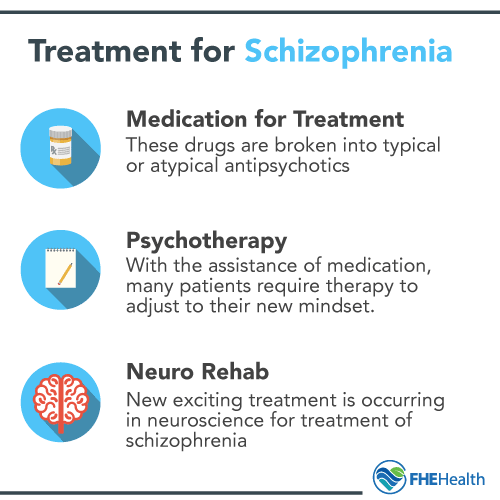
The best word to define the treatment of schizophrenia is “difficult”.
Treatment of this disease is the combination of help from several experts, therapy, medicine, and psychopharmacology.
Antipsychotic drugs are demonstrated to be exceedingly effective against the syndrome but it arrives with considerable side effects too.


Leave a comment